 中文
 Español
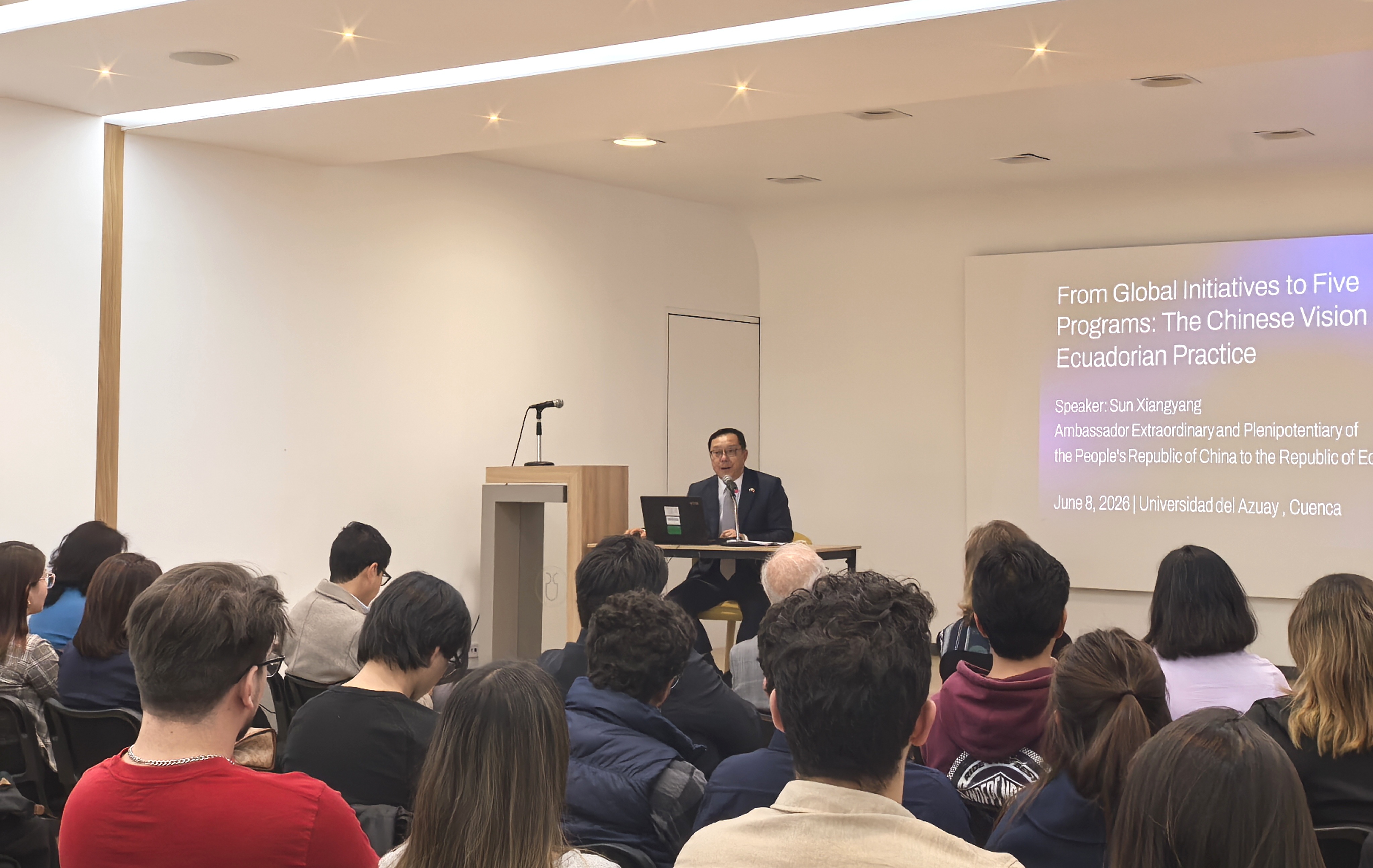
June 8, 2026, Azuay University, Cuenca
Thank you, Principal Francisco Salgado Arteaga,
It’s a great pleasure to be here today with my colleagues to visit University of Azuay, I’m very delighted to share with all of you, the students, faulty and the administrators, China’s Latin American Policy.
For Latin American people, the Ecuadorians included, China is faraway country in the east, separated by vast oceans. But we have an ancient Chinese poem saying, "True friendship knows no distance; even thousands of miles apart, we are still neighbors."
We have a lot in common. China and Latin America are both important members of the "Global South,"with ancient civilizations, independent diplomatic policy, shared pursuits of development and revitalization, and highly complementary economic structures, making us natural partners and friends.
In 2025 , trade between China and Latin America and the Caribbean reached US$565 billion. China is the largest trading partner of many Latin American countries, and Latin America is China's second-largest destination for outbound investment. Behind these figures lies the reality of a rapidly growing market of 2 billion people. In this grand symphony, Ecuador is an indispensable melody. The China-Ecuador relations featured with mutual respect, sincerity, and friendliness are writing a model of win-win cooperation with concrete actions.
The Chinese people has always cherished the ideal of "the world belongs to all", and "harmony among all nations","achieving self-improvement while helping others". Chinese diplomacy inherits and develops these excellent traditional Chinese cultural values,adhering to the principles of maintaining peace, advocating fairness, respecting rule of law, and pursuing openness and win-win cooperation.
Today, I would like to begin by briefing you the four global initiatives to rise to global challenges, and then introduce China’s latest blueprint guiding China-Latin America cooperation - the "Five Programs" and its Ecuadorian Practice.
From 2021 to 2025, Chinese President Xi Jinping successively proposed the Global Development Initiative, the Global Security Initiative, the Global Civilization Initiative, and the Global Governance Initiative, advocating that all countries work together to build a community with a shared future for mankind.
1. What development philosophy does humanity need, and how can global development be achieved ?
The global development initiative's answer lies in prioritizing development, putting people at the center, ensuring inclusive and equitable outcomes, driving innovation, and promoting harmony between humanity and nature. The initiative identifies poverty reduction, food security, climate change, and the digital economy as key areas of cooperation, putting development issues back to the core of the international agenda.
China was the first to implement this initiative, and its contribution to global economic growth has consistently remained around 30%. Under China's impetus, the Global Development Initiative has mobilized over US$23 billion in funding over the past four years to support the development and revitalization of the Global South, and has undertaken more than 1,800 cooperative projects.
2. What kind of security concept does the world need, and how can we achieve common security?
The answer from the global security initiative is to uphold a common, comprehensive, cooperative, and sustainable security concept; respecting the sovereignty and territorial integrity of all countries; abiding by the purposes and principles of the UN Charter; attaching importance to the legitimate security concerns of all countries; resolving differences and disputes between countries peacefully through dialogue and consultation; and coordinatingand maintaining security in both traditional and non-traditional areas.
Guided by this initiative, China has actively promoted political solutions to hotspot issues such as the Korean Peninsula and the Ukraine crisis, providing practical solutions for deescalating tensions and ending conflict in the Middle East.
3. What kind of civilizational ideals does humanity need, and how can we strengthen exchanges and mutual learning ?
The Global Civilization Initiative's answer lies in respecting the diversity of world civilizations, promoting shared values for all humanity, emphasizing the inheritance and innovation of civilizations, and strengthening international cultural exchanges and cooperation. It advocates transcending civilization barriers through exchange, overcoming civilization conflicts through mutual learning, and surpassing civilization superiority through inclusiveness.
In 2025, we will celebrate the International Day for Dialogue among Civilizations on June 10 for the first time, with a series of dialogue events taking place simultaneously around the world, from New York to Geneva, from Paris to Bangkok.
4. What kind of global governance system should we build, and how should we reform and improve global governance ?
The Global Governance Initiative tells us we have to uphold sovereign equality , abide by the rule of international law, practice multilateralism,advocate peoplecentered, and action-oriented approaches.
To this end, China, together with more than 30 countries, jointly established the International Court of Mediation, the first intergovernmental international organization dedicated to resolving international disputes through mediation. China also advocated the establishment of the World Artificial Intelligence Cooperation Organization, committed to bridging the global "intelligent divide".
The four global initiatives are not empty slogans, but action-oriented plans. They are open to all countries and do not attach any political conditions. It is within the framework of these four initiatives that China and Latin American countries have jointly launched a more regionally targeted cooperation blueprint, which is the "Five Programs".
On May 13, 2025, the Fourth Ministerial Meeting of the China-CELAC Forum was held in Beijing. Chinese President Xi Jinping delivered a speech at the opening ceremony, systematically summarizing the successful experience in the development of China-CELAC relations and formally announcing the launch of the "Five Programs" for jointly building a China-CELAC community with a shared future: the Programs of Solidarity, Development, Civilization, Peace and People-to-People Connectivity.
To implement the spirit of President Xi Jinping's important speech and promote the effective implementation of the "Five Programs",China released its third policy document on Latin America on December 10, 2025. This document serves as a roadmap and operational manual for the development of China-Latin America relations in the new era, and is available for online review.
Let's examine the vivid practices of China-Ecuador relations under the framework of “Five Programs”.
1. Unity Program – Strengthening the Political Foundation
The core objective of the Solidarity Program is to solidify the political foundation of China-Latin America relations. Specifically, we will continue to support each other on issues concerning their core interests and major concerns. China supports Latin American and Caribbean countries in expanding their influence on international arena and is ready to work together to firmly uphold the international system with the United Nations at its core and the international order based on international law.
Guided by the Solidarity Program, political mutual trust between China and Ecuador has been continuously deepened. For the past 46 years since the establishment of diplomatic relations, the Ecuadorian government has consistently and firmly adhered to the one-China principle, which China appreciates very much.
In June 2025, President Xi Jinping met with President Novoa in Beijing, emphasizing that both sides should be good friends respecting and trusting each other, and good partners for common development. The two heads of state jointly witnessed the signing of a cooperation plan for the Belt and Road Initiative. This is a concrete manifestation of the Solidarity Program's aim to "strengthen high-level exchanges and share experiences in governance."
2. Development Programs – Promoting Common Prosperity
The core objective of the development program is to promote common prosperity. Both sides will strengthen the alignment of development strategies, especially to deepen collaberation and cooperation in infrastructure, agriculture and food, energy and minerals, clean energy, 5G communications, the digital economy, and artificial intelligence. Both sides agree that development is the fundamental solution, only through development can deep-seated problems such as poverty and inequality be addressed.
These kind of cooperation between China and Ecuador has made considerable progress, such asin the fields of infrastructure, mining, trade, and technology.
the CCS Hydropower Plant, built by a Chinese company, has to date generateda cumulative 68 billion kilowwatt-hours of electricity, accounting for 30% of the country's total power generation. Chinese companies have built an important wind power plant in Ecuador and are actively exploring cooperation in photovoltaic power plant in Cuenca. For your information, President Daniel Noboa once told me all the world is using Chinese solar panels and he wishes Chinese solar companies to have distributors in Ecuador. There are indeed great potentials for our bilateral cooperation in the diversification of Ecuador’s energy supply.
Some of you may have concerns about Chinese companies operation in Ecuador. What about the environment protection of the Chinese companies? ECSA Mine in Mirador, operated by a Chinese company , was named "Most Sustainable Company of the Year" by Ecuador'smagazine EKOS in 2025, and has received “Green Certification” from your Ministry of Environment. Over its 20 years in Ecuador, Andes Petroleum, a Chinese investment company in Ecuador, has restored more than 500,000 square meters of vegetation and won 53 domestic and international environment awards, including the Outstanding Environment Compliance Award. All these demonstrate the sincerity and capability of Chinese enterprises in protecting the Amazon ecosystem.
Chinese companies have created nearly 8000 direct jobs and over 15,000 jobs in Ecuador. They pay all taxes in full. ECSA Mine alone has paid a total of 1.48billiion US dollars in taxes and fees to the Ecuadorian government from 2010 to 2025.
In the trade sector, the China-Ecuador Free Trade Agreement, took effect on May 1, 2024. In 2025, our bilateral tradereached US$17.33 billion, a year-on-year increase of 24%,from January to April in 2026 it reached US$6.28 billion, a year-on-year increase of nearly 20%. Half of Ecuador's shrimp export goes to China in 2025. Chinese mobile phones and automobiles are very popular among Ecuadorian users due to their excellent quality and affordable prices. Recently I visited Ciauto company under Ambacar in Ambato. I was told Chinese vehicles make up 60% of car sales in Ecuador, and probably 80 in 2 years, and Chinese E-vehicles account for 95%.
In the field of scientific and technological cooperation, China's innovation index has been listed the top ten globally, and technologies such as green energy and artificial intelligence are making continuous and significant progress. High-speed rail, Alipay, shared bicycles, and online shopping are known as China's "new four great inventions". We are ready to share these experiences with Ecuadorian friends, and explore new cooperation in emerging fields such as 5G communications, the digital economy, E-commerce and artificial intelligence.
In the area of people's livelihood, China and Ecuador have always been partners who help each other. After the devastating earthquake in Ecuador in 2016, projects aided or financed by China , such as the Chone Hospital, Manta Airport were completed. During President Noboa’s visit to China last June, the Chinese government provided Ecuador a grant of US$28.5 million.
The Chinese companies also make contribution to the people’s livelihood. ECSA mine has invested US$17.8 million in 2524 community support projects.Andes Petroleum has built 2 medical centres, providing routine healthcare to tens of thousands of local residents.
3. Civilization Program – Deepening Mutual Learning Among Civilizations
The core objective of the Civilization Project is to enhance mutual learning between Chinese and Latin American civilizations. Both sides will strengthen exchanges and cooperation in cultural heritage fields such as joint archaeology and ancient site protection, and allow Chinese and Latin American civilizations to radiate new vitality through mutual learning and exchange.
China and Ecuador are laying the foundation for mutual learning between civilizations. Currently , at least 17 educational institutions in Ecuador offer Chinese language courses, with institutions such as the Confucius Institute at the University of San Francisco in Quito and the Confucius Classroom at Siyuan Chinese Language School serving as important windows for learning Chinese and understanding Chinese culture. The Chinese government has provided scholarships to nearly 1,000 outstanding Ecuadorian students and has offered over 2,600 professional training opportunities in recent years. This year, 100 Chinese government scholarships will be awarded. We warmly welcome all students here to apply to their desired Chinese universities for further studies after graduation.
It is worth mentioning that Ecuadorian children's literature author Verónica Bonilla 's "Platanario's Journey to China" allowed Latin American children to know about China, for which she won the 15th Special Contribution Award for Chinese Books, becoming the first Ecuadorian recipient of the award.
Tomorrow, the Embassy and Cuenca Municipality will co-organize a Chinese Culture Week. Mayor Zamora and I will hold the opening ceremony, you will have the opportunity to learn the unique charms of the works of Chinese calligraphy, paintingand ceramics etc at the Cuenca Municipal Museum of Modern Art. The exhibition will run until June 20th, all of you are most welcome to the exhibition.
4. Peace Program – Maintaining Regional Stability
The core objective of the peace project is to maintain peace and stability in our region. Both China and Latin America agree on a common, comprehensive, cooperative, and sustainable security concept. China supports the "Announcement on the Declaration of Latin America and the Caribbean as a Zone of Peace" and the "Declaration of the 33 Latin American and Caribbean States on the Establishment of a Nuclear-Weapon-Free Zone". China is ready to work with Latin America to implement global security initiatives and strengthen cooperation in the field of disaster prevention and relief, cybersecurity, counter-terrorism, anti-corruption, and drug control.
In recent years, the China-Ecuador Treaty on Judicial Assistance and the Extradition Treaty have come into effect, and the two countries have carried out fruitful cooperation in law enforcement and judicial matters, anti-corruption and criminal repatriation. Ecuador currently faces a complex security situation. China is ready to provide more support to Ecuador in areas such as combating transnational crime, drug control cooperation, and cybersecurity, jointly safeguarding regional peace and security, and supporting Latin America's status as a "zone of peace."
5. People-to-people connectivity Program – Enhancing People's Friendship
The core objective of this program is to enhance the friendship between the Chinese and Latin American peoples. Good relations between states depend on the affinity between their people; only with mutual understanding can relations between countries move steadily and sustainably. China has formulated a series of cooperation measures with Latin America in areas such as social governance and development, poverty reduction, health care, and tourism, facilitating personnel exchanges and promoting people-to-people friendship.
According to the visa exemption agreement between China and Ecuador, holders of Ecuadorian ordinary passports can stay in China for no more than 30 days without a visa (excluding purposes such as study and work ). We welcome more Ecuadorian friends to travel, do business, study in China.
In the area of poverty reduction, China has trained agricultural technicians through the "rice-duck co-cultivation" project in Ecuador, resulting in increased production and income for farmers and ensuring that cooperation benefits ordinary people. In the area of educational equality, the "China-Ecuador Friendship Digital Classrooms" supported by our embassy, have been successively established in primary and secondary schools across Ecuador, helping to bridge the digital divide. For consecutive years, our embassy has also donated supplies such as food bags at its request to help various regions cope with natural disasters in Ecuador. Some people with ulterior motives have falsely accused this kind of support for the local people of being "political infiltration" by China, but the gratitude and joy of the recipients have demonstrated the pure nature of China-Ecuador friendship. It’s really ridiculous, one cann’t help but laughing at such accusations, we will be happy to see others doing such “political infiltration” for the Ecuadorian people. Actually these donations from the Embassy is small, but each one is directly related to relief of the disaster-affected families.
III. Conclusion: Setting sail for a bright future, the future lies in the hands of the youth.
Dear all, from its four global initiatives to its five programs, China has consistently been committed to providing solutions to common challenges facing humanity and building a cooperative platform for the common development of countries in the Global South. This is because China believes that true development is achieved only when everyone develops together, and true security is achieved only when everyone is safe.
No matter how grand the blueprint, it needs someone to draw it. The students here today are the future of China-Ecuador relations. With your knowledge received in this university and understanding of our bilateral friendship in your mind, I sincerely hope you could do something helpful to our continuous collaboration and cooperation - whether it's applying for scholarships to study in China, engaging in bilateral trade and emerging industries, or using your cameras to record stories of China-Ecuador friendship.
Thank you very much, thank you and I’m ready to have interchanges with you.